Solo · open source
ProseEdge — Accessible Post Formatter
- Role
- Solo — design and engineering
- Outcome
- Live and open source under AGPL-3.0 at v0.1 — the formatter ships first; the accessibility study and the on-device ranking model stay off until their evaluation exists
- Built with
- Next.js · React 19 · TypeScript · Tailwind CSS · Property-based testing · Accessibility
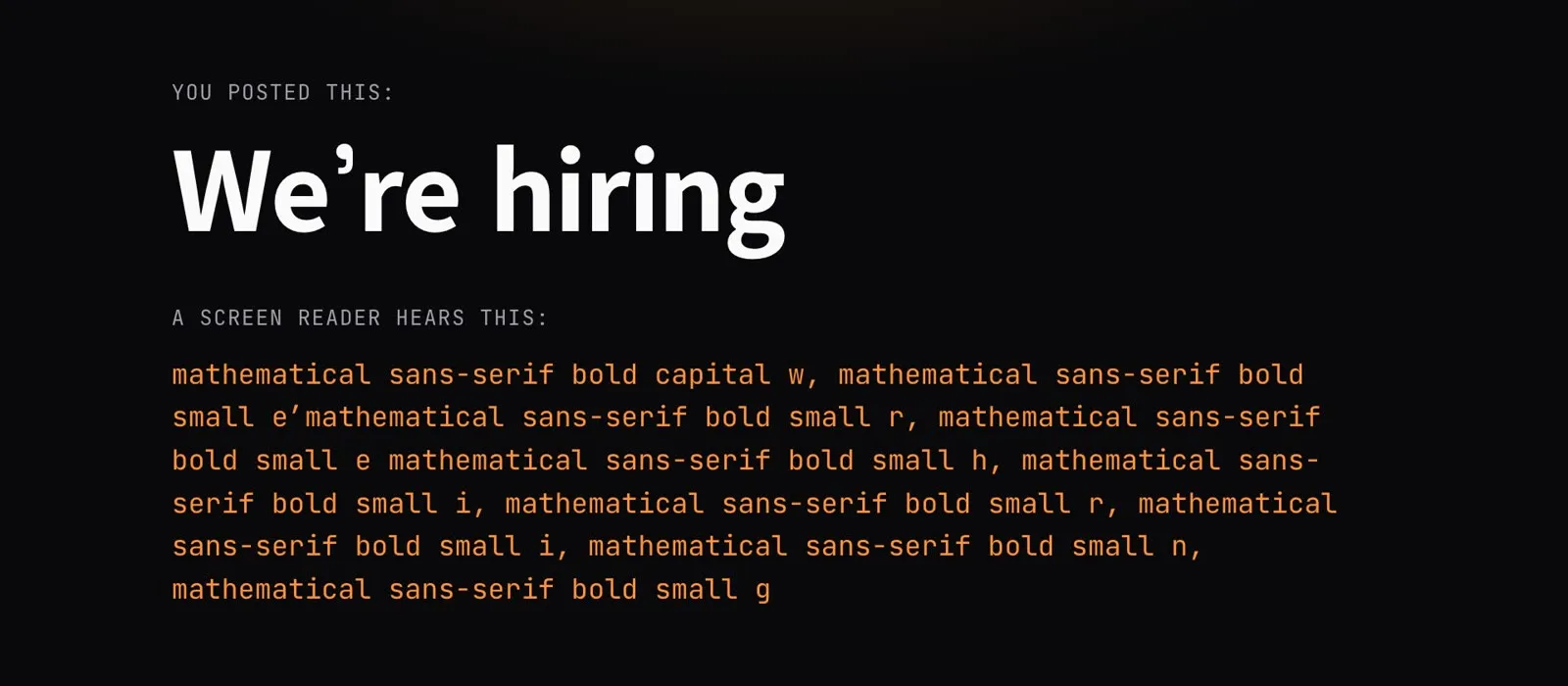
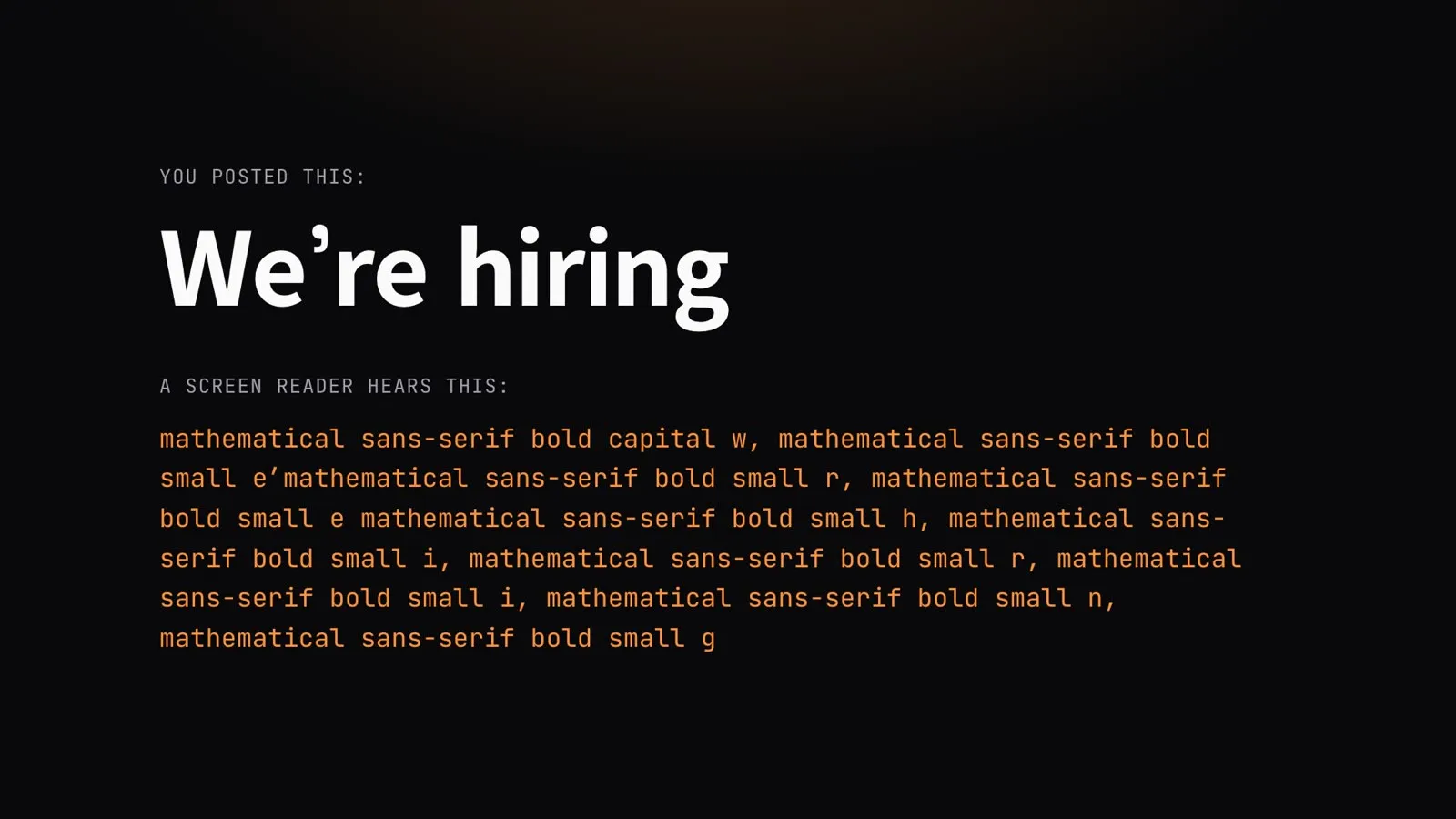
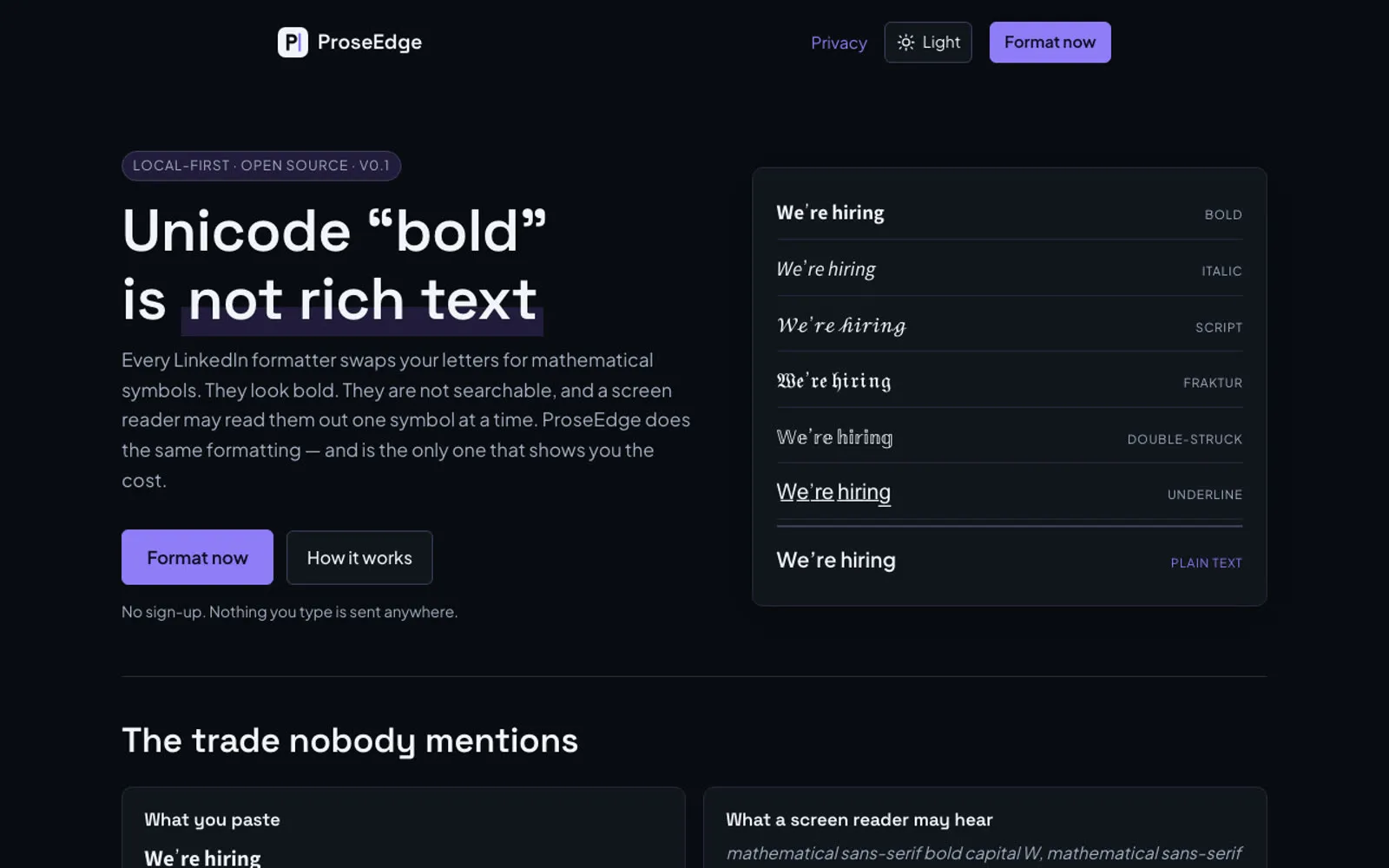
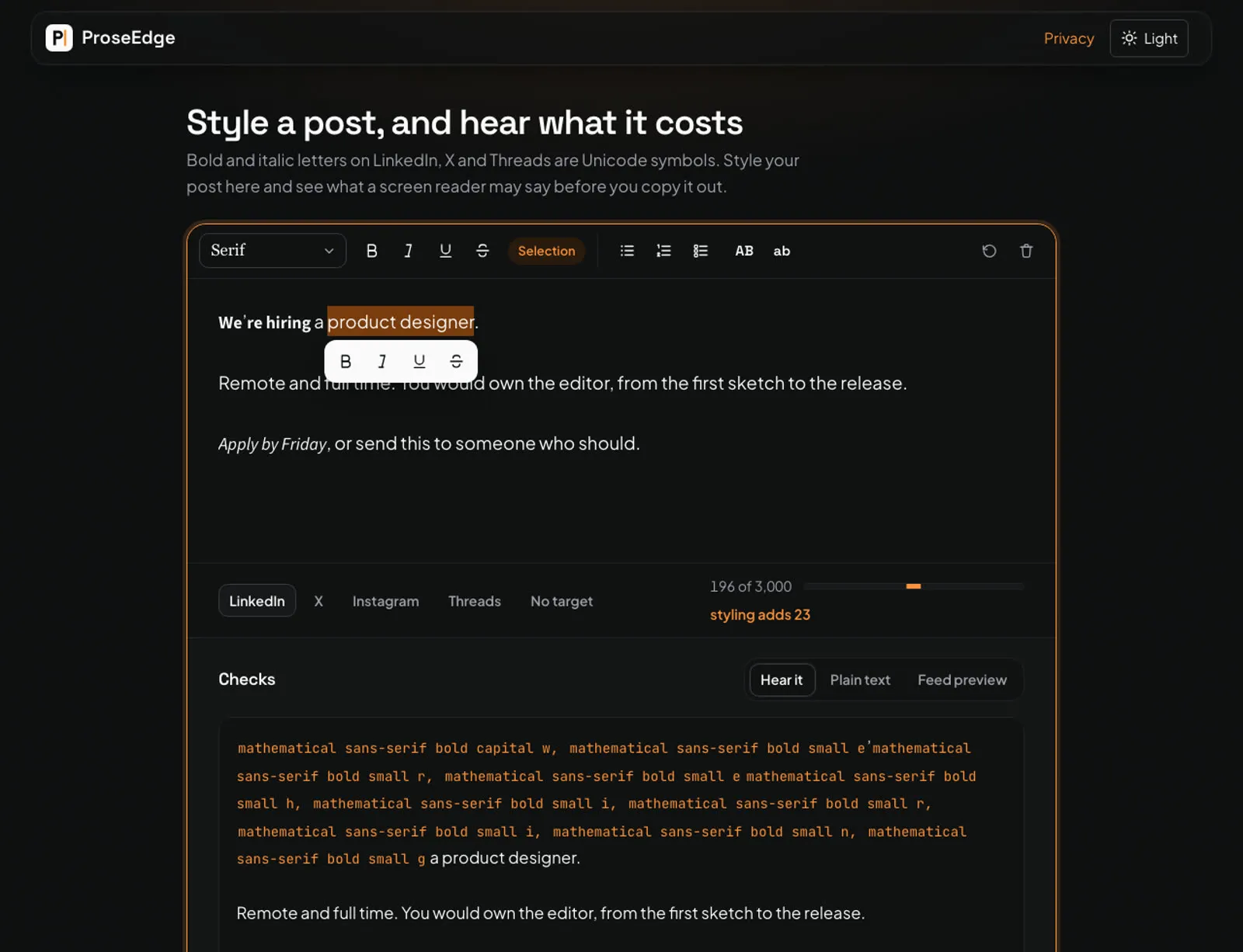
A local-first editor for social posts that use Unicode “bold” and “italic” letters, built to show what that styling costs before the post goes out. LinkedIn, X and Threads have no rich text, so writers substitute mathematical symbols that look like letters — and a screen reader reads them aloud as “mathematical sans-serif bold capital W”, one symbol at a time. ProseEdge styles the post across serif, sans, script, fraktur, double-struck and monospace alphabets, then sets the cost directly beside the choice: what a screen reader announces, how many extra characters the platform counts, and which letters a style cannot cover. Nothing typed leaves the browser. Built solo, end to end.
Problem
Every free “LinkedIn bold” tool performs the same swap — letters for Mathematical Alphanumeric Symbols — and none of them mention what it does to the people reading. The styled words are no longer searchable, each one costs two code units against the platform’s limit, and assistive technology either spells them out symbol by symbol or skips them. A second class of failure is quieter: most tools convert one way, so once a post is styled the plain words are gone, and a character the target alphabet does not cover is silently replaced with a lookalike rather than reported.
Approach
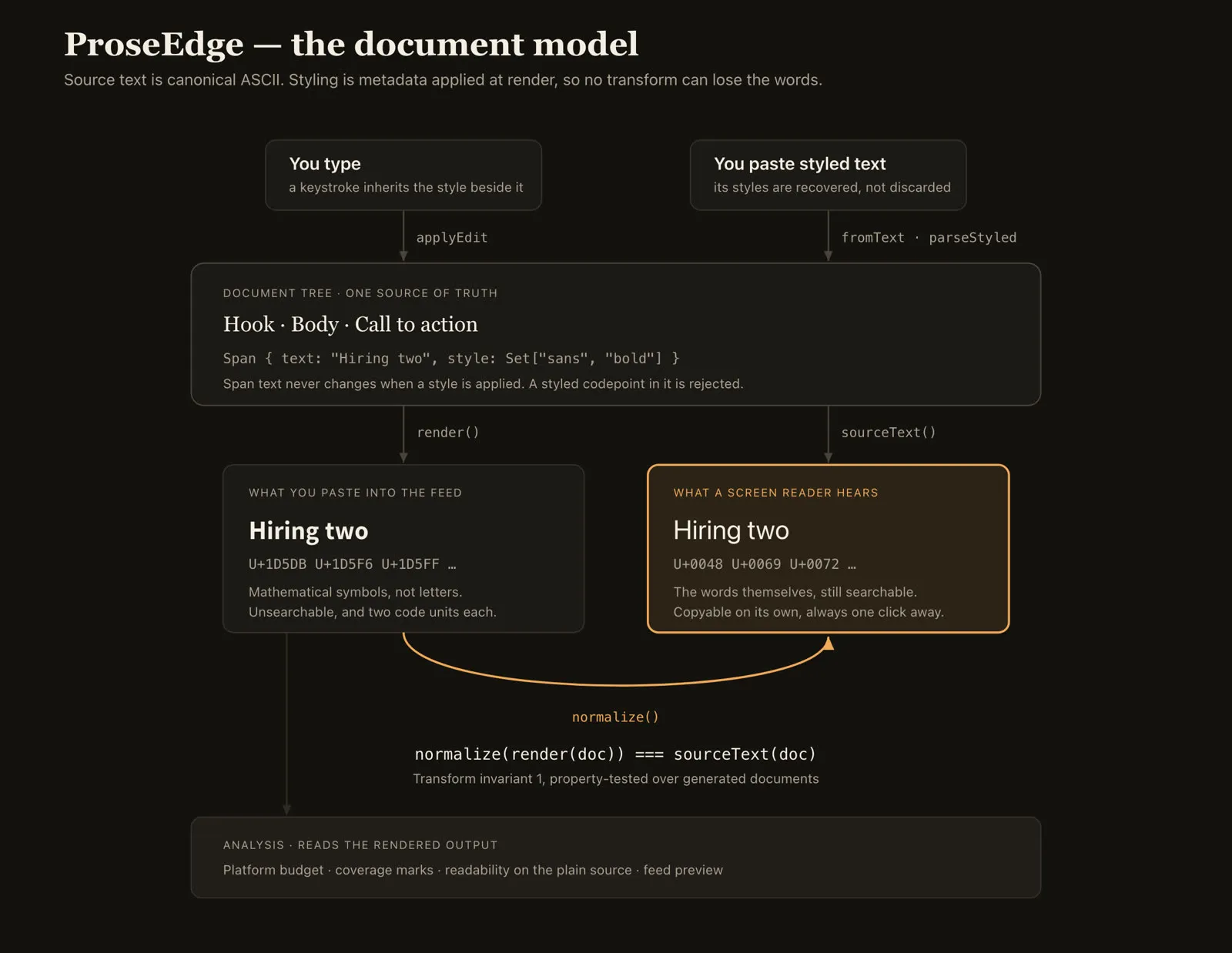
ProseEdge keeps the plain text as the single source of truth. The document is a tree of spans holding canonical ASCII, with styling held as metadata and applied only at render — so normalize(render(doc)) === sourceText(doc) for every document and every style combination. That invariant is property-tested over generated documents rather than asserted, and it is what makes every transform reversible and the plain-text copy always one click away. Pasted styled text is parsed back into the same tree, so styles are recovered rather than discarded. The screen-reader transcript is generated from the Unicode character names of all 726 styled code points, tested against UnicodeData.txt, and per-platform length budgets show the extra cost of each styled letter, with rules that are assumed rather than verified labelled as such. Privacy is enforced, not promised: an end-to-end test fails the build if anything typed leaves the page. The research features — an accessibility score and a compressed ranking model for openings that runs in the browser — are designed but kept switched off until they have a measurement behind them.
Screens